What Size Juicer Do I Need?
Two numbers answer this: how many ounces of juice you pour at once, and how tall the gap above your counter is.
By Brijon M. · Last reviewed October 17, 2026
Work it out from ounces of juice, not from the size of the machine. A generous glass is 12 to 16 oz, so one person needs a juicer that will produce about 15 oz without stopping, two people about 30 oz, and a family of four about 60 oz. Then measure the gap between your counter and the cabinet above it, because a vertical juicer is loaded from the top and has to fit under that gap with room to drop produce in. Those two numbers settle the question; almost everything else on a juicer spec sheet does not bear on it.
Capacity: the published figures
Only three brands on this site publish a capacity figure at all, which is why this question is so hard to answer from listings. Here is everything that is published:
| Machine | Published capacity | Household it covers |
|---|---|---|
| Kuvings AUTO10 | 100 oz hands-free hopper; continuous running up to 45 minutes | Several days of juice in one session |
| Breville Juice Fountain Cold XL | 70 fl oz juice capacity | A family of four, in one run |
| Nama J2 | 20-30 oz per batch, depending on ingredients | Two people |
| Nutribullet Slow Juicer | 24 oz catch cup | One person comfortably; two at a squeeze |
| Nama J3 | 10-15 oz per batch, depending on ingredients | One person, one glass |
| Omega J8006HDS / NC900HDC | Not available - continuous feed, no stated batch limit | Any size; the pulp tray is the only constraint |
| Kuvings REVO830 | Not available | Continuous feed; no published figure |
| Ninja NeverClog JC151 | Not available | Not published |
The two rows that cause the most regret are the Nama pair. The J3's stated 10-15 oz is a one-glass machine by design, and couples buy it constantly because it is the cheaper Nama with the same 50 RPM auger -- Nama J2 vs J3 is that decision in full. And the Nutribullet's 24 oz catch cup is the hidden ceiling on the best-value cold press on this site: it juices perfectly well, it just makes you stop and empty it.
Why a second batch is worse than it sounds
A cold press juicer is not a machine you top up. When a batch is done you empty the pulp container, and on a vertical that usually means lifting the chamber off. Running a second batch is not a second pour -- it is most of the process again, with the first glass going warm while you do it.
That is the mechanism behind the commonest reason an expensive juicer ends up in a cupboard. It is also entirely predictable from the published figures before you spend anything, which is why this page exists.
Continuous feed sidesteps the whole question
The cheapest answer to a capacity problem is a machine with no capacity. A horizontal masticating juicer pushes pulp out of the far end while juice runs out underneath, so there is no chamber to fill and no batch to finish -- which is why Omega publishes no capacity figure for the J8006HDS or the NC900HDC. You feed it until the jug is full.
So a mid-band horizontal often out-sizes a premium vertical costing twice as much. The trade is footprint and parts: Omega's NC900HDC is 19.22 in wide at 18.7 lb with more parts on the draining board than any vertical here. Vertical vs horizontal juicers is the full comparison.
Footprint: the measurement almost nobody takes
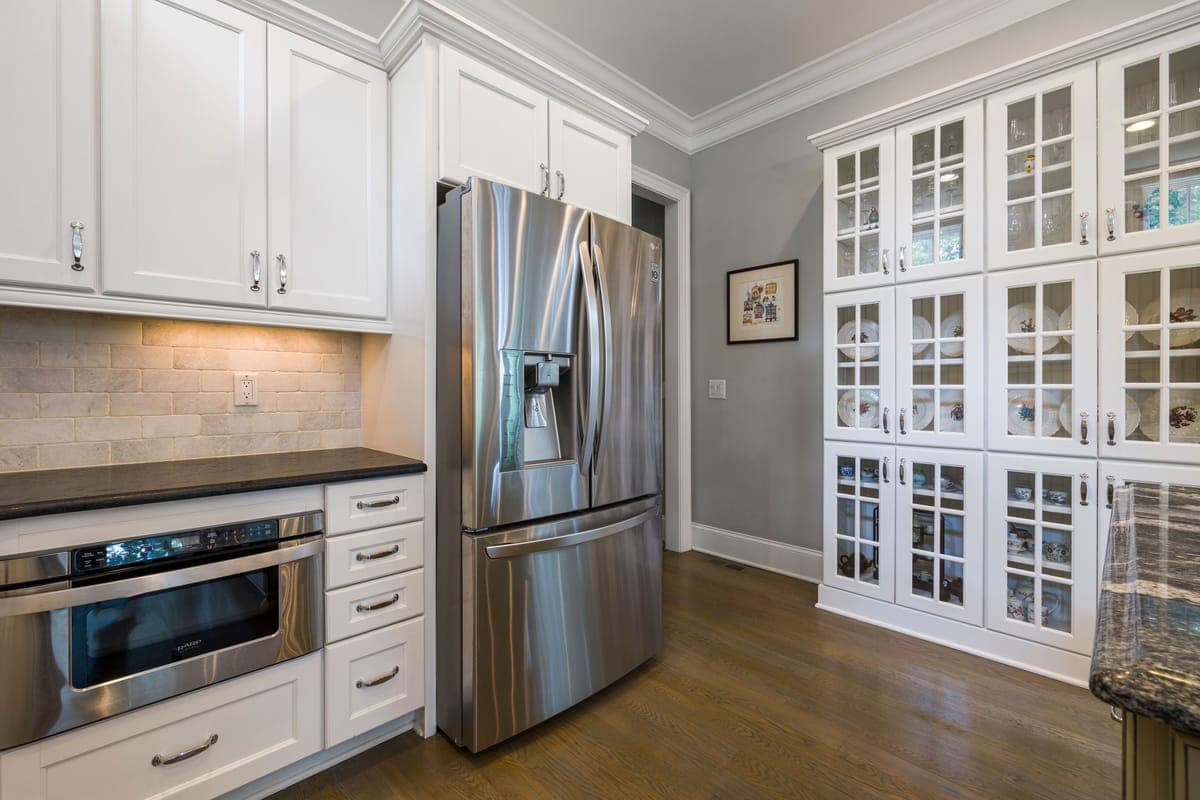
The size question that actually decides whether a juicer gets used is vertical clearance, not counter area. A vertical auger is loaded from the top, so you need the machine's height plus room above it to hold a carrot over the chute. A typical counter-to-cabinet gap is about 18 in.
- Nama J3 -- Nama states 8.9 in wide, 6.5 in deep, 15.4 in high, 9.7 lb. Clears an 18 in gap with a little room.
- Nama J2 -- Nama states 9.8 x 9.0 x 17.7 in, 12.1 lb. Does not clear an 18 in gap for loading; you will pull it forward each time.
- Nutribullet Slow Juicer -- Nutribullet states 17 in tall and 6.25 in wide. Tight but workable.
- Omega NC900HDC -- 19.22 in wide at 18.7 lb, but it is horizontal, so height is not the constraint. Counter depth and length are.
- Tribest Slowstar -- 19 lb, and it does not want to live in a cupboard. Weight is the constraint when a machine is stored low down.
The rule that follows from all of that: a juicer that lives on the counter gets used, and a juicer that lives in a cupboard does not. Weight and the awkwardness of the lift matter more than the published dimensions once a machine is stored out of sight. Juicer size and storage is the page on that specifically, and best compact juicers is the shortlist for a genuinely small kitchen.
What to look for, then three machines by household size
Check four things in this order: the published batch capacity in ounces (or confirm the machine is continuous feed); the height against your counter-to-cabinet gap; the weight if it will be stored low; and the chute width, because a narrow chute means more prep for the same volume of juice.
| Criterion | Nama J3 | Nama J2 | Kuvings AUTO10 Hands-Free |
|---|---|---|---|
| Yield | Nama states 10-15 oz of juice per batch, depending on ingredientsManufacturer claim: Nama · checked 2026-10-05 | Nama states 20-30 oz of juice per batch, depending on ingredientsManufacturer claim: Nama · checked 2026-10-02 | Not availableNot sourced |
| Pulp | Not availableNot sourced | Not availableNot sourced | Not availableNot sourced |
| Cleanup time | Nama states removable parts that rinse clean after juicing, with a cleaning brush included; no cleanup time publishedManufacturer claim: Nama · checked 2026-10-05 | Not available - no published cleanup time in minutesNot sourced | Not available - no published cleanup time in minutesNot sourced |
| Price | $400+Band from retailer listings, checked 2026-10-02 | $400+Band from retailer listings, checked 2026-10-02 | $400+Band from retailer listings, checked 2026-10-02 |
| Noise | Nama states the J3 runs quietly; no decibel figure publishedManufacturer claim: Nama · checked 2026-10-05 | Not availableNot sourced | Not available |
| Speed | Nama states 50 RPM and a rated power consumption of 130 WManufacturer claim: Nama · checked 2026-10-05 | Nama states 50 RPM, single-phase induction motor, 200 WManufacturer claim: Nama · checked 2026-10-02 | Kuvings states 50 RPM, 240 W, continuous running up to 45 minutesManufacturer claim: Kuvings USA · checked 2026-10-02 |
| Warranty | Nama states a 15-year warranty for all partsManufacturer claim: Nama · checked 2026-10-05 | Nama states 15 years on the motor, 2 years on partsManufacturer claim: Nama · checked 2026-10-02 | Kuvings USA states a 15-year warrantyManufacturer claim: Kuvings USA · checked 2026-10-02 |
For one person, the Nama J3 at a stated 10-15 oz per batch and 6.5 in deep -- or the Nutribullet Slow Juicer at a fraction of the money and a 24 oz cup. For two, the Nama J2 at a stated 20-30 oz, or an Omega horizontal for no limit at all. For a household batching several days at once, the Kuvings AUTO10 and its stated 100 oz hopper. The fuller versions are best juicers for one person, best juicers for two people and best juicers for families.
And if you have not settled on a type yet, best juicer machines sorts the field by mechanism, while how much celery for one cup of juice gives a sense of the produce volume sitting behind the numbers on this page.
Questions people ask
What size juicer do I need?
How many ounces of juice does one person need?
How much space does a juicer need?
Is a bigger juicer better?
Do I need a big juicer for a family?
What happens if the juicer is too small?
Sources
Every figure on this page traces to one of these. Where a source does not publish a number, the page says “Not available” rather than estimating one.
- Kuvings AUTO10 Hands-Free — 100 oz hands-free hopper, 50 RPM, 240 W, continuous running up to 45 minutes
- Breville Juice Fountain Cold XL — 70 fl oz juice capacity, 3.5 in feed chute, 1200 W multi-speed
- Nama J2 cold press juicer — 20-30 oz per batch, 9.8 x 9.0 x 17.7 in, 12.1 lb, 50 RPM, 200 W
- Nama J3 cold press juicer — 10-15 oz per batch, 8.9 x 6.5 x 15.4 in, 9.7 lb, 50 RPM, 130 W
- Nutribullet Slow Juicer — 24 oz catch cup, 17 in tall, 6.25 in wide, 65 RPM, 150 W
- Omega NC900HDC — Continuous feed with no stated batch limit, 80 RPM, 150 W, 15-year limited warranty
- Tribest Slowstar SW-2000 — 47 RPM, 200 W, 19 lb, duty cycle under 30 minutes continuous
Read next
Juicer Size and Storage
The three measurements that decide whether a juicer fits, and the published dimensions to check them against.
The Best Juicers for Two People
Six machines that pour two glasses in one run, chosen on published capacity -- the number that separates a two-person juicer from a one-person one.
The Best Compact Juicers
Small-footprint juicers with the actual published dimensions, for kitchens where counter space decides everything.
Nama J2 vs Nama J3
The hands-free J2 against the compact J3, decided on batch size and counter space rather than on juice quality.