How Cold Press Juicers Work
One auger, one screen, and a name that describes marketing rather than mechanics.
By Brijon M. · Last reviewed October 2, 2026
A cold press juicer is a screw turning slowly inside a perforated tube. Produce goes in the top, the screw drags it along and crushes it against the holes, juice goes through and fiber comes out the end. That is the entire mechanism, and understanding it explains every strength and every annoyance the category has.
The three names mean one machine
- Masticating is the mechanical description. The auger chews produce rather than cutting it.
- Slow juicer is the honest plain-English version. Our registry runs 43 to 110 RPM against 6,500 to 18,000 for centrifugal machines.
- Cold press is the marketing term. Nothing in a home juicer is pressed cold in the industrial sense -- the phrase stuck because slow crushing generates less heat and less aeration than a fast basket.
A listing using all three is describing one machine three times. It is not a feature list.
The four parts that matter
The auger
A tapered screw, usually a hard plastic or a composite. It does two jobs at once: it pulls produce in, and because it tapers, it progressively reduces the space available, which is what applies the crushing pressure. Omega states a triple-stage auger on the J8006HDS and a dual-edge auger on the VSJ843 -- those describe different approaches to the same job.
The screen
A perforated tube or basket, usually fine mesh. Juice passes through; fiber does not. This part determines how much fine pulp ends up in the glass, and it is also the slowest thing to wash, which is why the premium end of the category has started removing it. Hurom's Easy Clean design has no mesh strainer; Cuisinart's CSJ-300 uses a mesh-free filter.
The back-pressure
At the far end there is a restriction that stops fiber falling straight out, so the auger has something to squeeze against. On most machines this is fixed. On Omega's NC900HDC it is adjustable -- Omega states five end-cap pressure settings -- which is the only documented extraction control anybody publishes.
The chute
The least glamorous part and the one that most affects your daily life. A 45 mm chute, as Hurom states for the H400, means chopping. Kuvings states 3.5 in on the REVO830 plus a 1.75 in auto-cut chute specifically for celery and carrots. Chute width is the spec to read.
Why this mechanism suits fiber
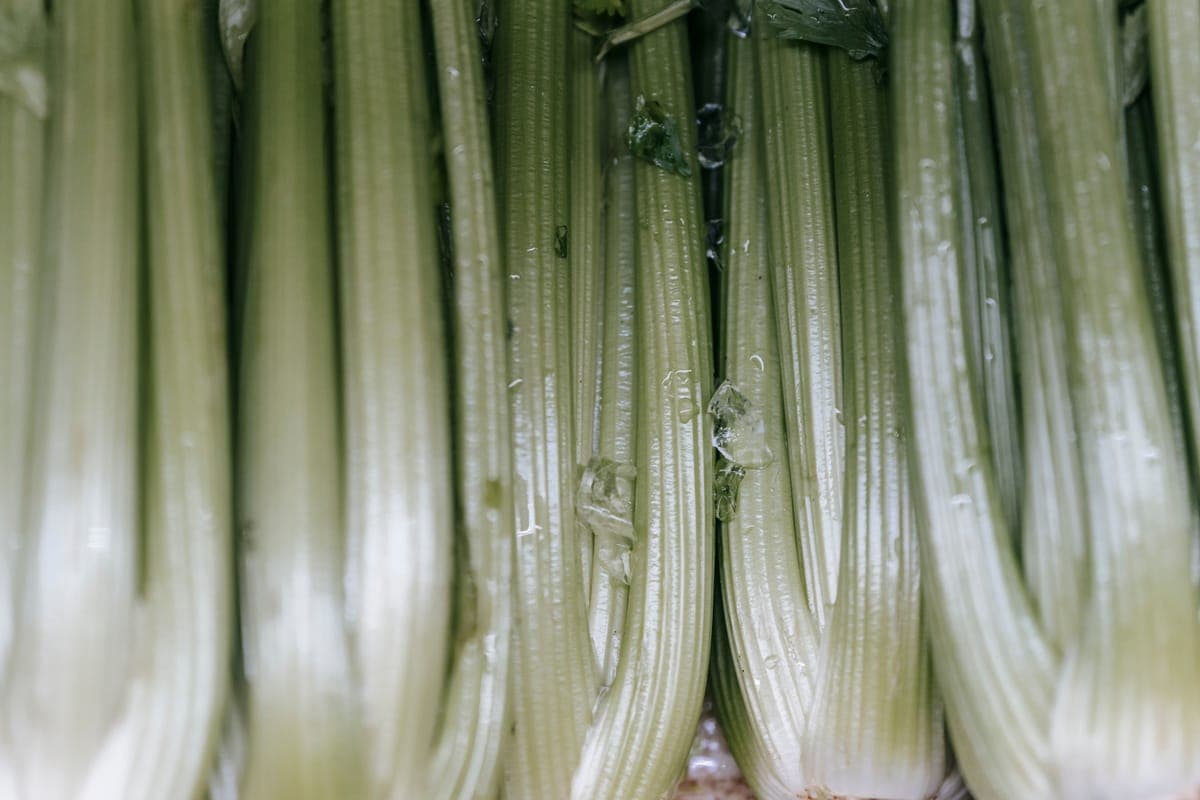
A celery stalk is long structural strands with liquid held between them. An auger grips a strand and crushes along its length, releasing that liquid. A spinning basket cuts across the strand at high speed, which mostly just relocates it -- so the strand arrives in the pulp bin largely intact and still wet.
On a hard apple the difference narrows considerably, because an apple is dense cell water rather than structural fiber and both mechanisms get at it. That is why we keep saying the mechanism question is really a produce question. Masticating vs centrifugal is the full comparison.
Why it jams, and what reverse does
The auger pulls fiber in faster than it can crush it, the space ahead fills up, and the motor stalls. Celery is the usual culprit because the strands are long enough to wrap the auger rather than being carried along it.
A reverse function turns the auger backwards, which unwinds the wrap and lets the blockage fall back out of the chute. Nutribullet and AMZCHEF both state one. Without it you are taking the drum apart. Juicer clogging fixes covers the technique that prevents it in the first place.
What the mechanism does not explain
Questions people ask
What does masticating mean on a juicer?
Is cold press juice actually pressed cold?
Why is my cold press juicer so slow?
What is the back-pressure setting on a juicer?
Do cold press juicers need a reverse function?
Sources
Every figure on this page traces to one of these. Where a source does not publish a number, the page says “Not available” rather than estimating one.
- Omega NC900HDC specifications — Five end-cap pressure settings, two screens, 80 RPM
- Hurom H400 Easy Clean — Strainer-free design, 45 mm chute, 90 RPM
- Kuvings REVO830 — 3.5 in chute plus 1.75 in auto-cut chute, 50 RPM
Read next
Cold Press and Masticating Juicers
The slow-auger category: vertical, horizontal and twin gear, judged on yield, pulp, cleanup time and price.
Masticating vs Centrifugal Juicer
The decision that constrains every other juicer choice, settled on the four criteria.
Cold Press Juicer Yield, Explained
Why cold press yield figures do not exist, and the kitchen test that tells you more than any of them would.
Juicer Clogging Fixes
Why fibrous produce jams an auger, how to prevent it, and which features actually help.
How Centrifugal Juicers Work
The spinning-basket mechanism explained, and why the same physics that makes it fast makes it fail on fiber.