Apple Juice Machines for Home
The machines that press apples by the bushel are cider equipment. At home the only spec that matters is whether the chute takes a whole apple.
By Brijon M. · Last reviewed October 17, 2026
For apple juice at home you want a juicer with a chute of 3 in or more, and the specific machine we would buy is the Breville Juice Fountain Cold XL -- Breville states a 3.5 in feed chute, 1200 W multi-speed and a 70 fl oz juice capacity, which is a jug of apple juice in minutes. The two-part answer behind that: the scratter-and-press equipment people picture when they search for an apple juice machine is cider-making gear for bushels of fruit, not a kitchen appliance -- and at kitchen scale, the only spec that genuinely changes the experience is chute width, because a medium apple is about 3 in across.
Two completely different machines share the name
Cider equipment works in two stages. A scratter or mill chops the fruit into pomace, then a rack-and-cloth or basket press squeezes the pomace under high force. It is built for a crate or a bushel at a time, it is sold through orchard and homebrew suppliers, and it is the right answer if you have an apple tree and want gallons in October. It is not a countertop appliance and nothing in the juicer market replicates it.
A home apple juice machine is a normal juicer. Apples are the easiest produce in this entire category -- dense, short-fibered and full of free liquid -- so almost any mechanism handles them. That is why this page's advice is unusually simple compared with the celery and kale pages on this site. If you genuinely need volume rather than a glass, best commercial juicers is the page for that end of it.
Chute width is the whole decision
A medium apple is roughly 3 in across. Every machine with a chute at or above that figure takes it whole; everything below it means quartering each apple first, which on a jug of juice is ten minutes of knife work you will resent by the second week.
| Machine | Published chute | Whole apple? | Mechanism |
|---|---|---|---|
| Kuvings REVO830 | 3.5 in, plus a 1.75 in auto-cut chute | Yes | Vertical auger |
| Breville Juice Fountain Cold XL | 3.5 in feed chute | Yes | Centrifugal |
| Breville JE98XL | 3 in feed tube | Most apples | Centrifugal |
| Hamilton Beach Big Mouth | 3 in Big Mouth chute | Most apples | Centrifugal |
| Mueller Austria Juicer Ultra | 3 in feed chute | Most apples | Centrifugal |
| Hurom H400 Easy Clean | 45 mm (1.8 in) | No - quarter it | Vertical auger |
| Tribest Greenstar Pro | 1.5 in chute opening | No - cut it down | Twin gear |
| Omega J8006HDS / NC900HDC | Not available - narrow horizontal feed | No - chop first | Horizontal auger |
Note what that table does to the usual hierarchy on this site: the widest chutes are on centrifugal machines and one vertical auger, and every horizontal masticating juicer -- the machines this site recommends for celery -- is the worst possible choice for apples on prep time alone. Best large chute juicers ranks on this spec by itself.
Centrifugal is a legitimate choice here
Apples are the produce that makes the case for a spinning basket. The reason this site normally steers people toward augers is long-fiber produce -- celery and kale, where a blade at 12,000 RPM travels along the fiber instead of rupturing the cells. An apple has short fiber and plenty of free liquid, so that failure mode does not apply, and a centrifugal machine is faster, cheaper and wider in the chute.
The two real costs are foam and juice life. Apple juice from a high-speed machine arrives with a visible head of air, which is why Breville includes a froth separator in the JE98XL carafe, and aerated juice does not hold up as well in a jar. If the juice is drunk immediately neither matters much. Juicer foam and oxidation and how long does fresh juice last cover both.
Browning, and the one thing that actually helps
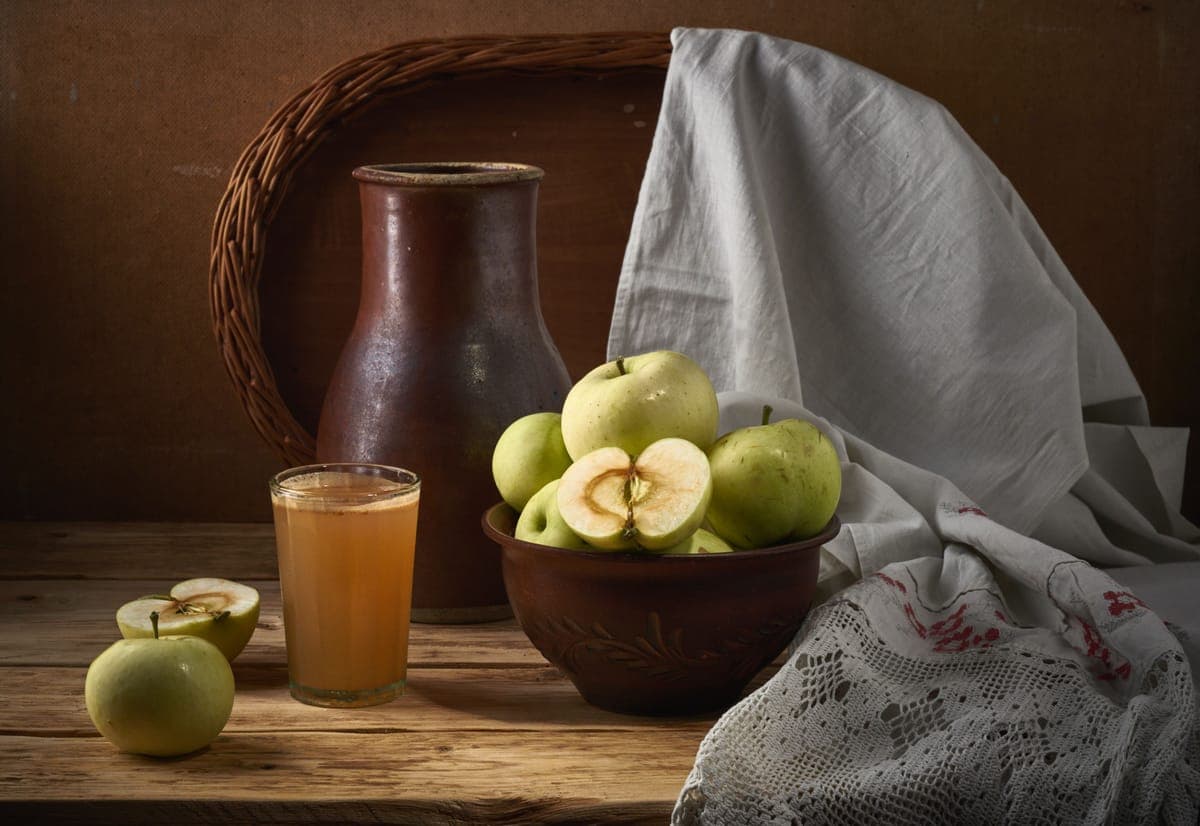
Fresh apple juice turns brown quickly. This is enzymatic browning -- the same reaction that darkens a cut apple on a plate -- and it is a color change rather than spoilage. Commercial apple juice is clear and pale because it has been filtered and treated; home-made apple juice is cloudy and goes tan, and that is the normal state of the product.
The practical fix is a squeeze of lemon into the jug, which slows the reaction, plus drinking it fresh and filling the container to the top so there is less air above the juice. Nothing about the machine changes this materially, though a lower-aeration auger juice browns a little more slowly. Juice oxidation explained is the full version.
What to look for, then three machines
Four things, in order: a chute of 3 in or more; enough capacity for the volume you want, since apple juice is drunk in quantity rather than by the shot; a froth separator or the patience to let it stand; and dishwasher-safe parts, because apple pulp dries to a varnish on a screen.
| Criterion | Breville Juice Fountain Cold XL | Kuvings REVO830 | Hamilton Beach Big Mouth Juice Extractor |
|---|---|---|---|
| Yield | Not availableNot sourced | Not availableNot sourced | Not availableNot sourced |
| Pulp | Not availableNot sourced | Not availableNot sourced | Not availableNot sourced |
| Cleanup time | Not available - no published cleanup time in minutesNot sourced | Not available - no published cleanup time in minutesNot sourced | Hamilton Beach states the food pusher, cover, strainer, pulp bin and strainer bowl are dishwasher safeManufacturer claim: Hamilton Beach · checked 2026-10-02 |
| Price | $200–400Band from retailer listings, checked 2026-10-02 | $400+Band from retailer listings, checked 2026-10-02 | Under $100Band from retailer listings, checked 2026-10-02 |
| Noise | Breville claims noise-reduction technology cuts mechanical noise by 40 percent; no decibel figure publishedManufacturer claim: Breville · checked 2026-10-02 | Kuvings describes the motor as noise-reduction; no decibel figure publishedManufacturer claim: Kuvings USA · checked 2026-10-02 | Not available |
| Speed | Breville states 1200 W, multi-speedManufacturer claim: Breville · checked 2026-10-02 | Kuvings states 50 RPM, 240 WManufacturer claim: Kuvings USA · checked 2026-10-02 | Hamilton Beach states an 800 W motor; no RPM publishedManufacturer claim: Hamilton Beach · checked 2026-10-02 |
| Warranty | Breville states a 1-year limited warrantyManufacturer claim: Breville · checked 2026-10-02 | Kuvings USA states a 15-year limited warranty (regional sellers list shorter terms)Manufacturer claim: Kuvings USA · checked 2026-10-02 | Hamilton Beach states a 3-year limited warrantyManufacturer claim: Hamilton Beach · checked 2026-10-02 |
The Breville Juice Fountain Cold XL is the fast one: a stated 3.5 in chute, 1200 W multi-speed and a 70 fl oz capacity, with a 1-year limited warranty as the catch. The Kuvings REVO830 is the one to buy if apples are only part of the plan -- a stated 3.5 in chute and a 1.75 in auto-cut chute for celery, at 50 RPM and 240 W with a 15-year limited warranty from Kuvings USA. The Hamilton Beach Big Mouth is the under-$100 answer: a stated 800 W, a 3 in chute, five dishwasher-safe parts and a 3-year limited warranty that triples Breville's.
For the single-produce version of this question see best juicers for apples, and if apples are one item on a longer list, best fruit juicers covers hard fruit, soft fruit and citrus together.
Questions people ask
What machine makes apple juice at home?
Do I need a cider press to make apple juice?
Is a centrifugal or masticating juicer better for apples?
Can you put a whole apple in a juicer?
Why does my home-made apple juice turn brown?
How many apples make a glass of juice?
Sources
Every figure on this page traces to one of these. Where a source does not publish a number, the page says “Not available” rather than estimating one.
- Breville Juice Fountain Cold XL — 3.5 in feed chute, 1200 W multi-speed, 70 fl oz juice capacity, 1-year limited warranty
- Kuvings REVO830 — 3.5 in chute plus a 1.75 in auto-cut chute, 50 RPM, 240 W, 15-year limited warranty
- Breville Juice Fountain Plus JE98XL — 3 in feed tube, dual speed 6,500 / 12,000 RPM, 850 W, froth separator
- Hamilton Beach Big Mouth 67601A — 3 in Big Mouth feed chute, 800 W, five dishwasher-safe parts, 3-year limited warranty
- Mueller Austria Juicer Ultra — 3 in feed chute, 2-year warranty; no RPM published
- Hurom H400 Easy Clean — 45 mm (1.8 in) chute, 90 RPM, 150 W, 15-year warranty on motor and parts
- Tribest Greenstar Pro — 1.5 in chute opening, twin gear, 110 RPM, 200 W
Read next
The Best Juicers for Apples
Four machines for apples, where a 3 inch chute saves more time than any other feature.
The Best Fruit Juicers
Seven fruit picks sorted by mechanism rather than rank, because apples, berries and oranges ask three different things of a juicer.
The Best Large Chute Juicers
Wide-chute juicers with published measurements, for people who do not want to chop before 7am.
Juice Oxidation, Explained
What oxidation observably does to juice, why machine speed affects it, and where we stop.